Explore Lebanon

Lebanon Travel Guide

Lebanon is a country immersed in history. Lying on the Mediterranean Sea, at the junction of Asia and Europe, Lebanon's cities and harbours were once major outposts in Phoenician and Roman times. The Békaa Valley, known in the 1st century BC as the 'granary' of Rome, is still the country's main agricultural region. One of the highlights of visiting Lebanon is the constant reminder of the country's long-standing role in the history of the world. Evidence of Phoenician and Roman occupancy is best seen at the pre-Roman historic site of Baalbek, known as the largest and best preserved Roman ruins in the world, and in the coastal cities of Saida (Sidon) and Jbail (Byblos), where tourists have the rare opportunity to snorkel amongst long-submerged Phoenician ruins.

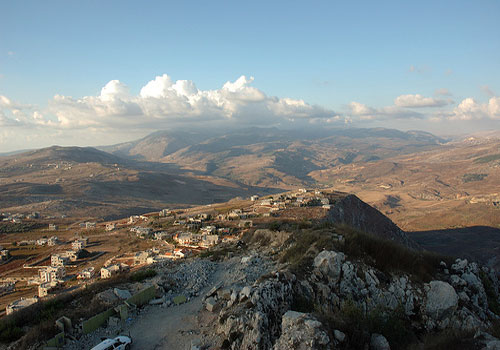
Lebanon has a remarkable natural landscape, especially considering the mostly desert countries surrounding it. There are four main geographic regions in Lebanon that can easily be identified on a map of the country. From west to east, there is the coastal plain, the Mount Lebanon Range, the Békaa Valley, and the Anti-Lebanon Range. Each region varies in topography and climate and what it can offer a visitor. Because Lebanon is a small country, day trips to historic coastal towns and lovely mountain villages are easily made from Beirut, the capital.

From 1975 until the early 1990s Lebanon endured a bloody civil war, which deeply scarred the country and its inhabitants, and took years to pick up the pieces. Enjoying moments of growth and prosperity Lebanon has slowly recovered and tourists have started visiting the country once again to indulge in its unique culture. In July 2006, Israel launched a month-long military campaign in Lebanon in response to the killing of three Israeli soldiers and the capture of two by the armed Shiite Muslim group, Hezbollah. Once more crippled by the conflict surrounding Israel, Lebanon is again rebuilding and ensuring that a ceasefire holds.

The ancient cities, ski resorts, impressive architecture and striking landscapes of Lebanon are just the start. The country is also known for its abundance of fresh fruit, vegetables and seafood and for its traditional starters, known as ' ', where 40 small dishes are served as appetizers. Beirut, known as the Paris of the Middle East, is a trendy and cosmopolitan city where a variety of languages, nationalities and religions assimilate. This melting pot of cultures is apparent in the colourful contrasts of the Mediterranean city where modern life plays out in the midst of ancient buildings, where churches and mosques sit adjacent to one another, and traditional and modern types live together in relative harmony.

Passports must be valid for three months after intended stay. Visas for certain nationalities can be issued upon arrival at Beirut Rakic Hariri International Airport provided the individual is coming for touristic purposes, holds a confirmed return/onward ticket and a clear address and telephone number in Lebanon. Entry to Lebanon will be refused if the traveller is holding a passport containing a visa for Israel, valid or expired, used or unused, or having any Israeli stamp endorsed on his/her passport.
Health risks for travellers to Lebanon are not excessive. A yellow fever vaccination certificate is required for travellers arriving from an infected country in Africa or the Americas. Typhoid vaccinations are recommended to all travellers with the exception of those who intend to stay in Lebanon for only a short period and take their meals in major restaurants and hotels. Typhoid cases are reported in Lebanon every year around rainy season as water levels rise and contaminated water from the sewers come to ground level. Medical facilities and healthcare in Lebanon are good. Doctors and hospitals usually expect immediate cash payment and treatment can be very expensive.
A large proportion of the population in Lebanon is Muslim so modest standards of dress and behaviour should be exercised. In certain areas, public displays of affection may cause offence and during Ramadan eating, drinking or smoking in public places between the hours of sunrise and sunset are frowned upon as it is forbidden by the Muslim culture. Possession, use and trafficking of controlled drugs are all serious offences in Lebanon and carry custodial sentences, and homosexuality is considered a criminal offence. Overstaying without the proper authority is also considered to be a serious offence. Photographing military personnel or installations and government buildings may lead to confiscation of photographic equipment, and possibly even imprisonment.
Tipping is customary in Lebanon. Porters, waiters, hotel staff, guides and doormen usually receive a 10-15% tip.
Javascript is required to view this map.
Featured Cities in Lebanon
Featured Airports in Lebanon
Toggle Electricity of Lebanon
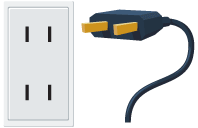
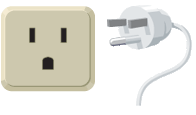
Flat blade attachment plug. Description
Flat blade attachment plug.
Voltage
110/220 V
Frequency
50 Hz
Type
A
Flat blades with a round grounding pin. Description
Flat blades with a round grounding pin.
Voltage
110/220 V
Frequency
50 Hz
Type
B
Round pins. Description
Round pins.
Voltage
110/220 V
Frequency
50 Hz
Type
C
Round pins, grounding pin and receptacle. Description
Round pins, grounding pin and receptacle.
Voltage
110/220 V
Frequency
50 Hz
Type
E
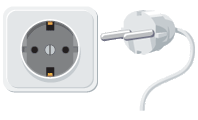
"Schuko" plug and receptable with side grounding contacts. Description
"Schuko" plug and receptable with side grounding contacts.
Voltage
110/220 V
Frequency
50 Hz
Type
F
Toggle Dialing Codes of Lebanon
Trip Tools
Toggle edit

International Weather


  • New York City
  • London
  • Hong Kong
  • New York CitySunny 28° /Sunny
  • LondonCloudy 15° /Cloudy
  • Hong KongThunder Storms 27° /Thunder Storms
© 2004 - 2010 TripExtras.com TripExtras.com is a trading style of Core8 Ltd which is an Appointed Representative of Astrenska Ltd. Astrenska Ltd is authorised and regulated by the Financial Services Authority under firm reference number 442233.
Top of Page Core8.com