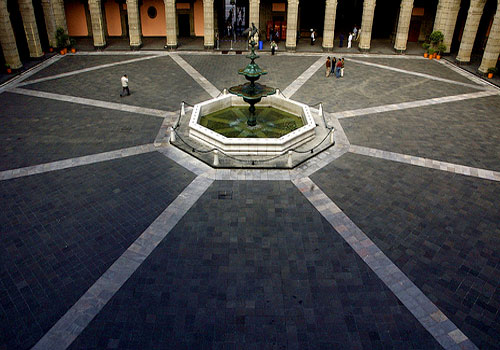
Explore Mexico City

Mexico City Travel Guide

Sprawling across a valley encircled by ice-capped volcanoes and mountains, atop an ancient Aztec civilisation, Mexico City is North America's highest city, and one of the worlds most densely populated. With a long and fascinating history that runs from ancient native civilisations through to the invasion of the Conquistadors and subsequent colonial rule, Mexico City has a vast number of fascinating sights and attractions.

In the city centre, constructed out of the stones of the ancient palaces and temples, is the vast open space of the Zócalo - Mexico's city square - said to be the second largest in the world after Moscow's Red Square. At La Merced you'll discover the city's largest and most vibrant market, with a vast array of bizarre and exciting stalls, while the huge expanse of the Bosque de Chapultepec park houses the National Museum of Anthropology, with a fascinating collection of pre-Hispanic artefacts. At Teotihuac´n visitors will discover one of the most impressive and mysterious archaeological sites in Mexico, constructed by an ancient, and long forgotten culture.

The sprawling capital is a place to both love and hate, with everything you'd anticipate in a large city. It has world-class museums and galleries, a remarkable architectural legacy and elegant buildings, palaces and cathedrals, green open spaces and colonial suburbs, historical ruins, attractive squares, modern skyscrapers and great economic, cultural and political importance. It also has poverty, overcrowding and slums, incredible pollution, traffic congestion, crime, unemployment, and a constant cacophony of people and noise. It is exhilarating, frenetic and fascinating, an unabated reserve of vibrancy and life.

Despite its problems and somewhat bewildering energy Mexico City is a magnet for Mexicans and tourists alike: a modern, cosmopolitan and ever growing city that is attractive in so many ways. Despite its renown for the appalling, throat-rasping levels of pollution, Mexico City's skies often remain remarkably clear, and it does make for incredible sunsets.

El Zócalo

Address: Mexico City

In the middle of the city's historic centre is the enormous paved Plaza de la Constitución, or Zócalo, the second largest city square in the world, and Mexico City's centre of government and religion. The Presidential Palace dominates one side of the square, a magnificent colonial building that was built on the site of the former Aztec Palace, with remarkable interior murals narrating the story of Mexico's history. Dominating an adjacent side of the square is the great Metropolitan Cathedral, displaying a wealth of architectural styles and occupying the site of the once sacred grounds of the Aztec. The ornate interior contains its chief treasure, the King's Chapel and gilded altar. The Cathedral is one of the buildings subsiding into the soft ground on which the city is built and builders are continuously at work to prevent its uneven descent. The square itself is filled with activity, with vendors and buskers, informal traditional Aztec dance performances, family groups, workers on lunch break and passing tourists. It is also the place for demonstrations, government rallies and protest marches, as well as festivals and public holiday events. Every evening the presidential guards, in a show of great ceremony, lower the national flag from the central flagpole. And encircling the square is the continuous buzz of the ubiquitous green Volkswagen taxis.

Templo Mayor

Address: Seminario 8, Historical District Mexico City

Admission: Museum: $45 (adults), children under 13 free Tuesday to Sunday, from 9am to 5pm

Telephone: 542-02-56

Templo Mayor (Great Temple) was the principal temple of the Aztecs, believed to mark the centre of the universe. It was part of the sacred complex of the ancient city of Tenochtitlán, and today it has been excavated to show the multiple layers of construction, viewed from a raised walkway with explanatory material available. The temple was first built in 1375, and enlarged several times, each rebuilding accompanied by a frenzied bloody sacrifice of captured warriors to rededicate the sacred area. At the centre is a platform on which stands a sacrificial stone in front of the shrine to the tribal god, Huizilopochtli. Within the site is the excellent Museo del Templo Mayor, a museum displaying artefacts from the original site and providing an overview of Aztec civilisation. The most important display is the first artefact to be discovered on the site, the great wheel-like stone carving of the Aztec goddess of the moon, Coyilxauhqui.

Palacio de Bellas Artes

Address: Eje Central Lázaro Cárdenas and Av. Juárez Mexico City

Admission: ($3) Adults Tuesday to Sunday 10am to 6pm

Telephone: (01)5512 3633

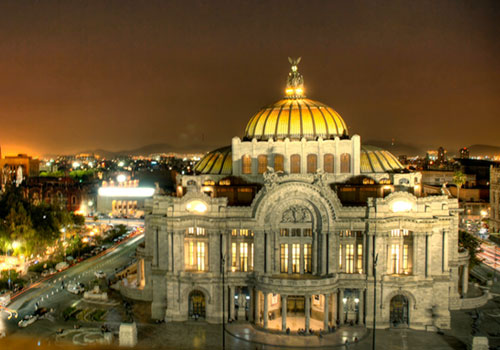
Situated at one end of the Alameda Central that was once an ancient market place and is now a large park, is the splendid white marble structure of the Palacio de Bellas Artes (Palace of Fine Arts). A concert hall and an arts centre, it houses some of Mexico's finest murals and the Art Deco interior is worth seeing alone. The Palacio has two museums: the Museo del Palacio de Bellas Artes and the Museo de la Arquitectura. The art museum's collection includes over 6,000 paintings, sculptures and engravings from 1650 to 1954 with masterpieces by prominent Mexican artists such as Diego Rivera, David Alfaro Siqueiros and Rufino Tamayo. One of the highlights of the Palacio is the theatre's stained glass stage curtain, which is lit before performances and for public viewing. The Ballet Folklorico performs here every Wednesday and Sunday.

Bosque de Chapultepec and the Museo Nacional de Antropología

Address: Avenida Paseo de la Reforma and calzada Ghandi, Chapultepec Park, Mexico City Mexico City

Admission: Museum: $51 (adults), children under 13 free. Free admission on Sundays to Mexican citizens Tuesday to Sunday 9am to 7pm

Telephone: (01)55 531 902

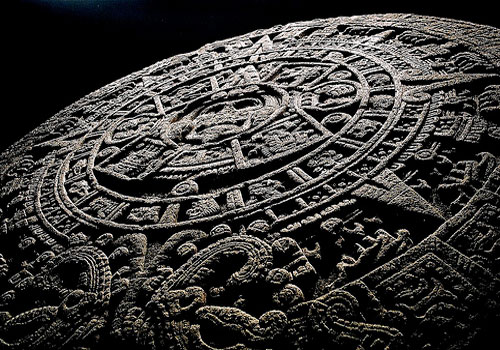
Bosque de Chapultepec is Mexico City's largest park, covering an enormous area containing lakes, the zoo and several museums, including the Museo Nacional de Antropología. The park attracts thousands of people, especially on weekends when families come to picnic, relax in the woods and visit the museums. The huge National Museum of Anthropology is one of the finest of its kind in the world, housing a fascinating collection of pre-Hispanic artefacts, from the first people in the Americas, to the Teotihuacána Empire, the Aztecs and the Mayans. Highlights include the famous Aztec Sun Stone or Calendar Stone found beneath the Zócalo (main square) in 1790. There are also exhibits illustrating the modern way of life in today's indigenous communities.

San Ángel

Address: Southwest of Mexico City Mexico City

Formerly a separate village, San Ángel is one of the more charming of Mexico's suburbs, an exclusive neighbourhood with ancient mansions and colonial houses along cobbled streets. It is famed for its Saturday craft market in the pretty Plaza San Jacinto, which brings colour, crowds and a festive atmosphere to the area, and has excellent art and handicrafts for sale. It is crammed with little restaurants and cafes, offering the city's best dining experiences, albeit expensive. There are several museums of interest, including the Studio Museum of Mexico's famous pair, the artists Diego Rivera and Frida Kahlo.

Zona Rosa

Address: Mexico City

The Zona Rosa (Pink Zone) is the city's major dining, nightlife and shopping district. It is a compact area, a dense knot of streets crammed with bars, shops, boutiques, restaurants and hotels. The streets are all named for famous cities such as Londres and Hamburgo and the best activity here is to people watch from a chic sidewalk café, as the endless stream of tourists and a mixture of the city's purposeful middle classes pass by. It is where the symbol of Mexico City stands, a gilded statue of Winged Victory, the Independence Monument.

Teotihuacán

Address: Mexico City

Admission: Tuesday to Sunday from 9am to 5pm

Telephone: (59) 4956 0276

Situated 31 miles (50km) from Mexico City, the UNESCO World Heritage Site of Teotihuacán is the site of Mexico's largest ancient city, constructed by a long forgotten culture, and dating from around 300 to 600 BC. It is believed that after thriving for about 2,000 years, a great fire caused the city to be abandoned and the Aztecs arrived in the region to find a forsaken city. Recognising signs of its previous magnificence they named it what it is today, Teotihuacán, 'place of the gods'. The central thoroughfare is the Avenue of the Dead, a 1.3-mile (2km) stretch lined with the palaces of the elite and connecting the three main site areas, the Pyramid of the Sun, Pyramid of the Moon and the Citadel. The Pyramid of the Sun is the third largest pyramid in the world, a huge red painted structure built over a cave, found to contain religious artefacts relating to sun worship. From the top of the stairs the views over the ruins are fantastic. The more graceful Pyramid of the Moon is situated at one end of the Avenue with an altar in the plaza believed to have been used for religious dancing. The Citadel at the other end of the Avenue is a large square complex that was the residence of the city's ruler. Within the walls is its main feature, the Templo de Quetzalcóatl, are some striking serpent carvings. The Tepantitla Palace holds Teotihuacán's most famous fresco, the faded 'Paradise of Tláloc'. There is a museum housing excellent displays of the city's artefacts, models and explanatory diagrams of the site.

Guanajuato

Address: Mexico City

Guanajuato is considered to be one of Mexico's colonial gems, founded around the rich silver deposits discovered by the Spanish in 1558. It is a city of history, where the cry of rebellion against the Spanish was raised and the struggle for Independence began, a history of wealthy silver barons and oppressed Indian miners. The city has an unusual layout, crammed into a narrow valley, with houses and streets forced into irregular positions due to the naturally hilly topography. Brightly painted higgledy-piggledy houses perch on the slopes, reached by narrow crooked alleyways of cobbled stone; hidden plazas, steep irregular stairways, underground tunnels and thoroughfares lend the city much of its charming character. Along with its picturesque setting and unusual beauty, Guanajuato has many historical buildings and magnificent architecture, including several churches and museums, and has been declared a UNESCO World Heritage Site. The most narrow, and most visited, alley is the Callejón del Beso (Alley of the Kiss) where the balconies of the leaning houses on either side almost touch each other, a feature in the local romantic legend about furtive lovers exchanging kisses. Cultural events are an important part of the city, which hosts several festivals during the year. Every weekend the famous strolling musicians, or callejoneadas, in traditional dress, lead processions through the narrow winding alleyways, strumming, singing and telling stories to the crowds that follow.

Candlemas Day

Where: Streets and churches throughout the city,Mexico City

When: 2 February, annually

Marking the end of the festive season, 40 days after Christmas, Candlemas Day (Candelaria) is a citywide and nationwide traditional celebration, partly religious and partly pre-Hispanic. A chosen member of each family hosts a party, offering tasty tamales and atole (a beverage made from corn). There are numerous street parades with groups carrying representations of Baby Jesus to church where special masses are held, markets and fiestas in the streets and important bullfights at the Plaza de Toros Monumental.

Festival of Mexico

Where: Various,Mexico City

When: March 2010 TBA

The 'Festival del Centro Historico' (Festival in the Historic Centre) was inaugurated in 1985 as an exercise in aid of rescuing and restoring the historic art and architecture of Mexico City's degenerating town centre. The event has now earned a reputation as one of the most vibrant celebrations of art and culture in Latin America. During the two-week festival each year more than 100 performances take place from opera and chamber music, through jazz, folk and pop to theatre, and classical ballet. In addition there are exhibitions, gourmet food, master classes and workshops, conferences and lectures by renowned artists, authors and poets.

Xochimilco Festival

Where: The canals of Xochimilco,Mexico City

When: April 2010 TBA

The lakeland area of Xochimilco, just over 10 miles (16km) south of Mexico City, with its canals, colourful barges and floating gardens, provides a fitting setting for an annual festival honouring the ancient Aztec goddess of flowers and the goddess of dance. A lucky girl is chosen as 'La Flor Mas Bella del Ejido' (the most beautiful flower of Ejido) and leads a floating parade of flower-bedecked barges through the canals. The four-day festival includes canoe races and horticulture contests, and takes place two weeks before Easter every year.

Independence Day

Where: Zocalo and city streets,Mexico City

When: 15-16 September, annually.

Mexicans celebrate the anniversary of their independence from Spain with great gusto, particularly in Mexico City where the day before the event the Zocalo fills with throngs of people from early morning, awaiting the appearance of the president on the balcony of the National Palace. At 11am the president duly appears to shout 'the Cry', a re-enactment of the 1810 call to independence by Father Hidalgo. The emotional crowd replies with 'Viva!' and the city erupts with excitement, abuzz with street parties and fireworks. The following day a three-hour military parade begins at the Zocalo and ends at the Angel monument on the Paseo de la Reforma.

Day of the Dead

Where: Various,Mexico City

When: 1 - 2 November annually

A Mexican tradition with Aztec roots is the honouring of the departed with traditions that nowadays closely resemble those of Halloween celebrated to the north. In Mexico City markets and stores are liberally stocked with flowers, candy skulls, paper skeletons and candles. Processions are made to cemeteries, where vigils or even parties are held. Visitors to Mexico City who want to make the most of the celebration head for Mixquic, a mountain pueblo south of the city, which hosts an elaborate street fair and solemn processions to the town cemetery.

Cinco de Mayo

Where: Puebla, east of Mexico City,Mexico City

When: 5 May annually

Every Fifth of May (Cinco de Mayo) in the state of Puebla, the famous Battle of Puebla is commemorated with traditional music and dancing and general festivities. The Battle saw a smaller Mexican army defeat a larger and more equipped French army on 5 May 1862. Ironically the day is probably more celebrated in the United States than it is in the rest of Mexico, in a similar fashion to the celebrations of St. Patrick's Day.

Izote

Address: 513 Av. Presidente Masaryk, Polanco Mexico City

Food Type: Mexican

Named for the delicate white flowers that adorn the yucca plant, Izote serves classic Mexican fare in an elegant, minimalist setting. The food is prepared using local ingredients such as yucca flower, cactus, and masa (corn flour), and menu favourites include the lobster enchiladas and barbecue lamb. Try the Tarta Zaachila (chocolate pastry filled with nuts) for dessert. Open Monday to Saturday for lunch and dinner, and Sunday for lunch. Reservations recommended.

Café Tacuba

Address: 28 Tacuba, Centro Histórico Mexico City

Food Type: Mexican

Dating back to 1912, Café Tacuba has a very colonial atmosphere, its décor featuring brass lamps, oil paintings and a mural of nuns working in a kitchen. The authentic Mexican menu offers traditional dishes including tamales, enchiladas, chiles rellenos and pozole, while their pastries and hot chocolate are legendary. Open daily for breakfast, lunch and dinner; reservations recommended.

Cantina La Guadalupana

Address: 2 Higuera and Caballo Calco, Coyoacán Mexico City

Food Type: Mexican

Cantina La Guadalupana is a comfortable, old-fashioned restaurant with a rather nostalgic atmosphere. The restaurant serves complimentary snacks such as jicama slices with lime and chilli, while menu favourites include the beef tartar and the traditional albóndigas (meatballs). Open Monday to Saturday for lunch and dinner; reservations recommended.

La Opera

Address: 10 Cinco de Mayo, Centro Histórico Mexico City

Food Type: International

La Opera is a luxurious dining venue with dark wood booths and linen-covered tables, its décor featuring gilded baroque ceilings and beautiful oil paintings. An added feature is the bullet hole which revolutionary general, Pancho Villa, supposedly put in the ceiling when he galloped into the restaurant on horseback. The menu offers an array of sumptuous cuisine including Spanish tapas and red snapper with olives and tomatoes. Open Monday to Saturday for lunch and dinner, and Sunday for lunch. Reservations recommended.

Restaurant Danubio

Address: 3 República de Uruguay, Centro Histórico Mexico City

Food Type: Spanish

Open since 1936, many celebrity diners have frequented the classic-European dining room of Restaurant Danubio, in the Centro Histórico. The restaurant's menu offers superb Spanish cuisine prepared on an ancient coal and firewood stove. The seafood at Restaurant Danubio is excellent - be sure to try the langostinos (baby crayfish). Open daily for lunch and dinner; reservations recommended.

Nightlife options in Mexico City are vast and varied, ranging from piano bars, music lounges and traditional Mexican bars to salsa and jazz clubs or trendy nightclubs. San Angel, Polanco, Condesa and La Zona Rosa are popular nightlife areas in the city, and there are many late night venues that are open till the early hours. There is a weekend entertainment guide in The News, available at local newsagents. Popular bars in Mexico City include both Rioma and Rexo in the Condesa district, as well as Cosmo Bar and the Hotel Habita's rooftop bar in Polanco. Shelty is a busy English pub on Avenida Campos Eliseos, and the Black Horse pub in Condesa is also good. Barracuda on Nuevo Leon has great jazz music, while Bar Jorongo and Café Tenampa are renowned Mariachi venues. Some of the best nightclubs in Mexico City include Avant-Garde, Living Room and Mama Rumba, all located in the Roma district. If you're keen to see some authentic Polynesian dancing, head to Mauna Loa on Avenida San Jeronimo. Many of the top hotels in Mexico City offer live entertainment at their in-house discos and lobby bars. It is safest not to walk around alone at night in the city and only official, pre-ordered taxi cabs should be used.
Shopping in Mexico City is a fun and vibrant experience offering authentic local crafts as well as all the major brands and stores one might expect in any major city. The best Mexican souvenirs tend to be Talavera tiles and ceramics, embroidered garments, sterling silver jewellery and accessories, and hand-woven rugs and blankets. One of the most popular shopping areas in Mexico City is the Centro Histórico, home to most of the city's original stores, while La Zona Rosa is also well established. Most recently, the La Condesa and Polanco areas have developed as strong retail centres. Centro Santa Fe, in the western part of the city, is the largest shopping centre in Latin America, while the upscale Perisur shopping mall to the south is also a good stop. There are many markets in the city offering Mexican handicrafts, including the San Juan Market of Mexican Curiosities and the Mercado la Ciudadela in Centro Histórico, as well as the Bazar Sábado (Saturday Bazaar) in San Angel. Fonart outlets throughout the city also sell local crafts such as hand-painted crockery and blown glass. Most shops in Mexico City are open from 9am to 8pm, with smaller shops taking a break between 2pm and 4pm. The 15% VAT charged on goods can be reclaimed at the airport on purchases exceeding 1200 pesos (£48). Traveller must present a completed reimbursement request form, banking information, passport, immigration form (visa, tourist card), plane ticket, purchase receipts and goods purchased.
Javascript is required to view this map.
Featured Airports in Mexico City
Close Toggle Mexico City Weather Forecast
TodayTomorrowSaturdaySundayMonday
 
18° 18° 18° 17° 17°
Light RainLight RainShowersShowersRainRainRainRainShowersShowers
More information at MSN Weather
(Data provided outside US and Canada by Foreca, Data provided for US and Canada by WDT)

 
 JanFebMarAprMayJunJulAugSepOctNovDec
Average High21°22°24°25°26°24°23°23°22°22°22°21°
Average Low 10°11°12°13°13°13°12°11°
TodayTomorrowSaturdaySundayMonday
 
64° 65° 63° 63° 63°
Light RainLight RainShowersShowersRainRainRainRainShowersShowers
More information at MSN Weather
(Data provided outside US and Canada by Foreca, Data provided for US and Canada by WDT)

 
 JanFebMarAprMayJunJulAugSepOctNovDec
Average High70°72°76°78°79°76°74°74°73°73°72°70°
Average Low 45°46°50°53°55°57°56°56°55°52°48°45°
Toggle Electricity of Mexico City
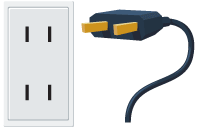
Flat blade attachment plug. Description
Flat blade attachment plug.
Voltage
127 V
Frequency
60 Hz
Type
A
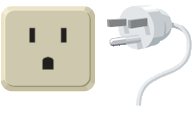
Flat blades with a round grounding pin. Description
Flat blades with a round grounding pin.
Voltage
127 V
Frequency
60 Hz
Type
B
Toggle Dialing Codes of Mexico City
Trip Tools
Toggle edit

International Weather


  • New York City
  • London
  • Hong Kong
  • New York CitySunny 28° /Sunny
  • LondonCloudy 15° /Cloudy
  • Hong KongThunder Storms 27° /Thunder Storms
© 2004 - 2010 TripExtras.com TripExtras.com is a trading style of Core8 Ltd which is an Appointed Representative of Astrenska Ltd. Astrenska Ltd is authorised and regulated by the Financial Services Authority under firm reference number 442233.
Top of Page Core8.com