Malta Travel Guide
It has been said that the Maltese islands are the 'open air museum of the Mediterranean', offering 7,000 years or more of history to explore with numerous cultural, historical and megalithic sites unique in the world. The islands boast prehistoric ruins older than Stonehenge and the Pyramids of Egypt, and are steeped in the legacy of the medieval order of the Knights of St John, who used the island as their stronghold for defending Christendom.
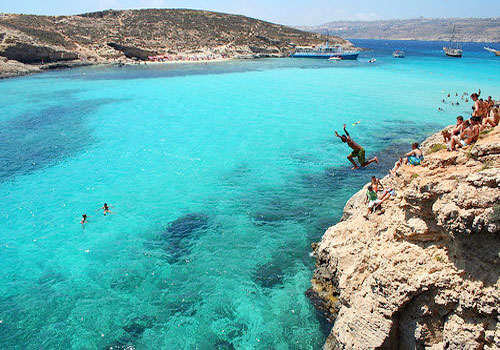
The main island of Malta, covering just 95 square miles (246 sq km), is also a popular holiday destination because of its secluded bays and sandy beaches, washed by unpolluted clear blue waters. Set against the backdrop of the island's scenery and its honey-coloured stone buildings, Malta is alluring and fascinating.
Malta and its little sister island, Gozo, are not stuck in a time warp, however. The islanders enjoy life to the full, and the calendar is filled with summertime 'festas' with fireworks and revelry in every little parish in honour of the village patron saints, as well as the major carnival in early spring every year. The capital, Valletta, besides offering some awesome Baroque buildings and fortifications as its main sightseeing attractions, is bustling and bursting with restaurants and cafes. The island's compact size is also a plus for visitors; it takes no more than an hour to drive between any two points on the main island, and there is very little open space. The dense population means that the island is virtually one large urban area, with buildings occupying every inch.
Malta lies about 60 miles (97km) south of Sicily and 160 miles (257km) north of Libya, a strategic position in the Mediterranean that has made the islands a crossroads of history. The last occupiers were the British, who granted Malta independence in 1964, but the biggest and most unique influence was left by the Knights of St John, to whom the island was donated in 1530; the Knights reigned supreme over the island for 270 years, building magnificent churches and monuments to themselves.
Malta has its mysteries too, in the form of 30 prehistoric sites boasting massive Neolithic temples, considered to be the oldest freestanding stone buildings known to man.
St John's Co-Cathedral
Address: Republic Street Valletta
Admission: EUR6 (adults), free for children under 12 Monday to Friday 9.30am to 4.30pm; Saturdays 9.30am to 12.30pm
Telephone: 2122 0536
Valletta's magnificent medieval cathedral is famous for the painting by Caravaggio, which hangs in its oratory, and the 369 inlaid mosaic marble tombstones that cover its floor. Each tombstone depicts the lives of the Grand Masters of the Order of St John, buried beneath. The façade is rather severe and militaristic, but inside the cathedral is lavishly splendid in the grandest tradition of high Baroque, with every inch of wall covered by carving, while the vaulted ceiling sports paintings depicting the life of St John the Baptist, patron saint of the Knights.
Palace of the Grandmaster
Address: Palace Square, Republic Street Valletta
Admission: Monday to Friday, 9am to 5pm
Telephone: 56 221 221
The Grandmaster's Palace, built around 1571, today serves as the office of the President and seat of the Maltese Parliament. The palace is a treasure house of art, from the unique collection of Gobelin Tapestries to frescoes depicting the Great Siege of 1565 by Perez d'Aleccio that cover the walls of the Halls of St Michael and St George. Visitors can also view the armoury and state apartments, which are adorned with friezes describing the history of the Order of St John.
National Museum of Archaeology
Address: Charles Borg, Auberge de Provence, Republic Street, Valletta Valletta
Admission: EUR5 (adults), EUR2.50 (children 6-11) Daily 9am to 7pm
Telephone: 21 239 375
The archaeological museum on Republic Street is housed in one of the inns of the Knights of St John, the Auberge de Provence. The museum's focus on Malta's prehistory includes displays such as the reconstruction of prehistoric remains found at Hypogeum. Items such as pottery, sculptures, statuettes, stone implements and jewellery from the prehistoric, megalithic and temple-building periods are featured, as well as some Punic and Roman tomb furniture. All the exhibits were found on excavations across the Maltese islands.
Lascaris War Rooms
Address: Lascaris Ditch, Valletta Valletta
Admission: Closed until further notice
Telephone: 2123 4936
Valletta suffered a great deal of damage during bombing raids in the Second World War. The Battle of Malta and other events involving the islands during the early years of the war are featured in a series of 17th century tunnels, which were turned into a military operations complex during the war. The complex has been restored and now acts as a museum, with displays including charts, models and dioramas.
Malta Experience
Address: Mediterranean Conference Centre, Mediterranean Street, Valletta Valletta
Admission: Show times: Monday to Friday every hour from 11am to 4pm, Saturdays and Sundays 11am to 1pm (until 2pm from October to June)
Telephone: 2124 3776 or 2125 1284
A dramatic presentation that illustrates the history of Malta, from Neolithic to modern times, can be enjoyed at the Mediterranean Conference Centre at St. Elmo's bastion in Valletta. This building itself has been impressively restored, having been built by the Knights in the 1500s as a hospital. The wards, which are great sweeping halls with vaulted ceilings and marble floors, now serve as exhibition areas. A modern theatre has been added where the Malta Experience audio-visual show is offered in 10 languages.
Mdina
Address: Valletta
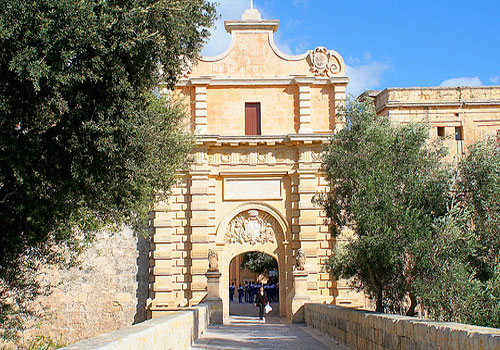
Mdina, known as the noble city, was the original capital of Malta before the arrival of the Knights of St John in the middle ages. It was originally a Phoenician town but spent periods under Roman, Arabic and Norman occupation. The elegant walled city, with its suburb, Rabat, can trace its origins back more than 4,000 years, although today all that remains is the medieval town, which has been largely restored. It is situated on a rocky outcrop about nine miles (15km) west of Valletta. At the heart of Mdina is its landmark Baroque Cathedral of St Paul. Mdina has a conservative atmosphere, in keeping with its noble past. While the Knights reigned over Malta the city became the home of the Maltese nobility, who lived there under autonomous rule, not being deemed worthy to be invited to join the Order of St John. The descendants of some of these families live here still. Mdina and Rabat not only offer some fascinating and valuable sightseeing opportunities, but the old city is particularly inviting at night when it is lamplit and visitors can enjoy the ambience of restaurants tucked away in its bastions and palace courtyards. Motor vehicles are off-limits inside the city walls, and pedestrians have free reign to walk the streets and take in a glimpse of life in the middle ages.
Three Cities
Address: Valletta
Malta's main maritime towns have merged into a fortified conglomerate known as the Three Cities, resting on the promontories opposite Valletta. Walking tours of the area are popular. Vittoriosa is the oldest town in Malta after Mdina. It features plenty of historical architecture, including several of the Inns of the Knights of St John, as well as a hospital built by the Order in 1672, which is still a Benedictine convent inhabited by devout nuns. Fort St Angelo, the oldest fortified part of Vittoriosa dating from 1274, stands at the tip of the promontory, and the Museum of Maritime History is also well worth a visit. The youngest of the Three Cities, Cospicua, dates from 1717 and features some interesting churches, while Senglea, designed by Grandmaster De La Sengle in 1551, is an important place of pilgrimage. Senglea's parish church contains a statue of Christ the Redeemer that is said to have miraculous powers.
Hal Saflieni Hypogeum
Address: Burial Street, Paola Valletta
Admission: EUR20 (adults), EUR12 (children 6 - 11). Advance booking required Daily 9am to 11am and 1pm to 4pm (only 10 visitors per hour)
Telephone: 2180 5018/9
The Hypogeum, just southwest of the Three Cities in the suburb of Paolo, is a labyrinthine complex of man-made chambers hewn out of limestone, extending about 36ft (11m) below the surface. Experts believe it was used as a burial site and temple by Neolithic man, who used antlers and stone picks to carve out the labyrinth in semi-darkness nearly 5,000 years ago. The site has been declared a UNESCO World Heritage site. Archaeologists have recovered numerous statues, amulets, figurines and vases, many of which are on display in the Archaeology Museum in Valletta.
St Mary's Church
Address: Rotunda Square, Mosta Valletta
Telephone: 2143 3826
The centre of every Maltese town and village is occupied by a beautiful church. One of the largest in Europe is St Mary's in the central Maltese town of Mosta, with its glorious blue, gold and white dome. The church is regarded as having been the site of a World War II miracle: in 1942 while 300 people were praying in the church a bomb penetrated the dome and landed on the mosaic floor, but did not explode. A replica of the bomb is today displayed in the church sacristy.
Hagar Qim
Address: West of the village of Qrendi Valletta
Admission: EUR9 (adults), EUR4 (children 6-11) Daily 9am to 5pm
Telephone: 2142 4231
The prehistoric temple complex discovered in 1839 at Hagar Qim in western Malta dates from about 3,800 BC, and has the oldest known human structures in the world. The Hagar Qim and nearby Mnajdra ruins are close to the village of Qrendi, about nine miles (15km) southwest of Valletta. The megalithic temple complex carved from giant limestone slabs is adorned with carved animals and idols, sacrificial altars and oracular chambers, all fashioned with flint and obsidian tools. The largest megalith is 23ft (7m) high and weighs about 20 tons. Many of the relics recovered from the site, including the famous 'fat lady' statues, are on display in the National Museum of Archaeology in Valletta.
Museum of Archaeology
Address: Triq Bieb l-Imdina, the Citadel Gozo
Admission: EUR8 (adults), EUR4 (children 6-11) Daily 9am to 5pm
Telephone: 2155 6144
A good place to begin exploring Gozo is at the Museum of Archaeology, found just inside the walls of the Citadel in Victoria behind the Old Gate, in a 17th century building that was originally the Town Hall. The museum illustrates the cultural history of Gozo from prehistoric times to the early modern era, presented chronologically from the Neolithic and Temple Period onwards through the Phoenician, Roman, Medieval and Knights of St John periods.
Ggantija Temples
Address: Temples Street, Xaghra Gozo
Admission: EUR8 (adults), EUR4 (children 6-11) Daily 9am to 5pm
Telephone: 2155 3194
Two massive megaliths were carved into temples by the pre-Phoenician Gozitans somewhere between 4,100 and 2,500 BC, and now stand on the island as mysterious monuments to a bygone age. Legend has it that they were transported to the island by a giantess called Sansuna, hence the name of the site, Ggantija, which means 'giant'. Large stone balls in the area, however, have led archaeologists to conclude that the massive blocks were rolled into place atop these. The two temples have a common façade but each has a separate entrance; one is larger than the other. It is believed both originally had roofing made of wooden beams, and that sacrifices of animals were made in the temples during rituals. The temples, along with other similar temples on the main island of Malta, have been documented as the oldest free standing structures in the world.
Caves of Xaghra
Address: Gozo
Admission: Calypso Cave is free, but there is a fee of 75c for Xerri's Grotto Xerri: Monday to Saturday 9am to 6pm; Ninu: daily 8.30am to 6pm
Telephone: 2156 0572
The alabaster caves at Xaghra feature stalactites and stalagmites, and have an important place in Greek mythology, particularly the Calypso Cave, overlooking the red sand of Gozo's best beach, Ramla Ihamra. Calypso cave is believed to be the one referred to in Homer's Odyssey as being where the beautiful nymph Calypso kept Odysseus as a 'prisoner of love' for seven years. Two other caves at Xaghra are Xerri's Grotto and Ninu's Grotto, both more impressive than Calypso, but lacking the love story. Below Calypso Cave are the remains of a fortification built by the Knights of St John as a defence bastion.
Dwejra
Address: Gozo
Dwejra, with its secluded pebbled bathing pool and crystal clear water, is known as the 'inland sea' and provides the enjoyable experience of diving into the 'blue hole' near the Azure Window. It is an area with strange rock formations causing interesting swimming holes. It's most famous rock is Fungus Rock, which was apparently heavily guarded during the era of the Knights of Malta because a special plant with healing properties grew upon it, and stealing the plant was liable to earn the thief the death penalty.
Marsalforn
Address: Gozo
The tiny fishing village of Marsalforn on the north coast of Gozo has become the island's most popular summer resort. It offers various spots for swimming and water sports, and is well supplied with restaurants, bars and accommodation establishments.
Toy Museum
Address: 222 Triq ir-Repubblika, Valletta Valletta
Admission: Lm1 per person Open Monday to Friday from 10am 3pm; Saturday and Sunday from 10.30am 1.30pm
Telephone: 2125 1652
Located in Valetta, the Toy Museum showcases three floors of Maltese and international toys dating back to the 1950s, including matchbox cars, planes, dolls, train sets and an impressive Corgi car collection.
Playmobil Funpark
Address: HF80, Industrial Estate, Har Far
Admission: Lm0.50 (adults); Lm1 (children) Winter: October to June open daily from 10am 6pm. Summer: July to September open Monday to Saturday from 10am 6pm; Sunday from 10am 1pm
Telephone: 2224 2445
The second largest Playmobil factory in the world is located here in Malta and the Playmobil Funpark is a must for children of all ages. Children can view the full range of Playmobil and run around in the play park. Tours of the factory are also available. There are both indoor and outdoor play areas so it's a great option for those rainy days.
Splash & Fun Park
Address: Coast Road, Bahar ic-Cahaq
Admission: Full day pass: EUR18 (adults); EUR10 (children). Half day pass: EUR10 (adults); EUR6 (children) 4 April - 28 June and 14 September - 1 November: open 9.30am 5.30pm; 29 June 13 September: Open 9am 9pm
Telephone: 2137 5021
The Splash & Fun Park is a great place to take the kids on a warm summers day where they can swim and ride the water slides to their heart's content. There is also a large whirlpool where adults can relax and unwind while the kids get rid of their energy on rides such as the Black Hole, Super Bowl, Side Winder, Hippo Slide and Children's Splash Land.
Popeye Village
Address: Anchor Bay, Mellieha
Admission: Free. Tokens can be bought for rides Open daily. August, 1 December 20 December: 9.30am 7pm; 21 December 6 January: 9.30am 8.30pm; March July, September October: 9.30am 5pm; November, January and February: 9.30am 4.30pm
Telephone: 2152 4782/3/4
Also known as Sweethaven, Popeye Village is the actual set that was used for the 1980s musical of Popeye that starred Robin Williams. Children can wander round the authentic wooden buildings such as the bakery, pot office and school house. During the summer months, visitors to Popeye Village can enjoy a boat ride or even water trampolines and meet their favourite cartoon characters.
Mediterraneo Marine Park
Admission: EUR18 (adults); EUR14 (children) Open daily from 10am 5pm; Winter: Open Monday to Friday from 10 5pm; Closed weekends
Telephone: 2137 8781
At the Mediterraneo Marine Park, children will be able to enjoy learning about marine animals by watching Black Sea Dolphin shows and the exciting and entertaining show by South American Sea Lions. Parrots and Iguana are also on display here. There is even a 'swimming with the dolphins' programme available for those wanting to get a little closer.
Personalise this page
- London:
Voltage230 VFrequency50 Hz
- New York City:
Voltage120 V Frequency60 Hz
- Hong Kong:
Voltage220 V Frequency50 Hz